
Every child’s journey is unique, and it’s natural for parents and caregivers to have questions along the way. We’re here to support you.
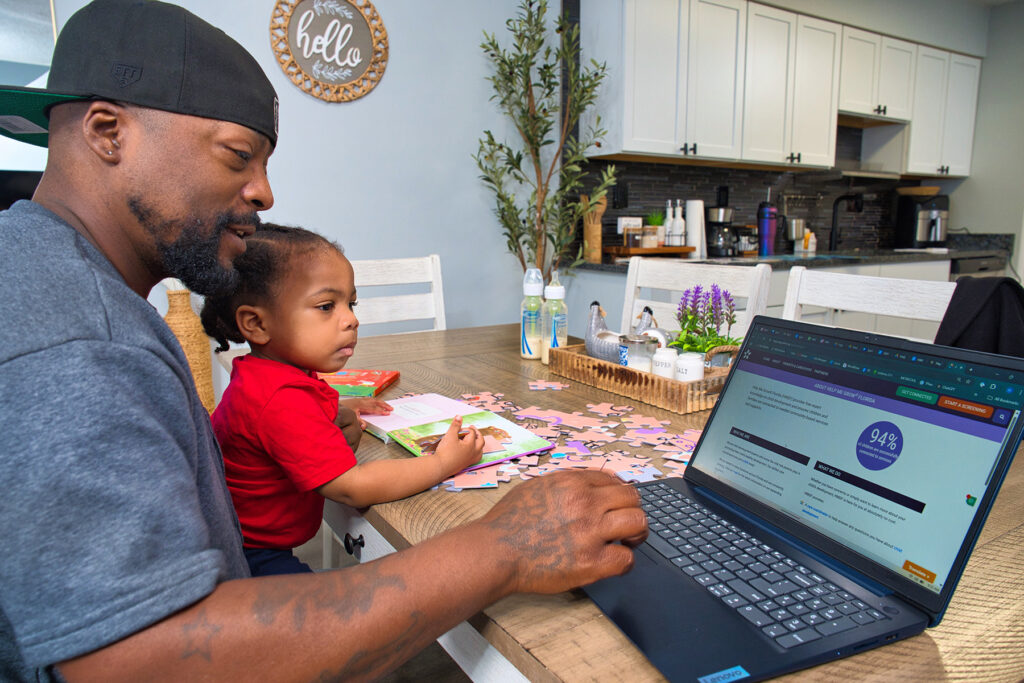
Help Me Grow Florida (HMGF) helps to promote healthy development for every child in our state. By identifying children who may be in need of developmental, behavioral, or learning supports, HMGF connects families with community-based programs for health and developmental services at no cost. More specifically, HMGF provides:
Parents and caregivers of young children, birth through age eight, who reside in a Florida county with an HMGF affiliate, are eligible for services. See if your area is served by Help Me Grow!
Service providers, health care professionals, and community partners can also benefit from HMGF’s information and services to support the families they serve.
HMGF is free! This includes screenings, information, resource connections, and follow-up support. Many referral agencies in HMGF communities connect families with free, low-cost, or sliding fees for program services.
Yes, surveillance and screenings are recommended for all children to ensure they are developing appropriately. HMGF supports families in many ways, even if their child does not have a disability or issue of concern.
A developmental screening is a short questionnaire to assess if a child is achieving age-appropriate milestones, such as taking a first step, using a fork and spoon, or waving “bye-bye.” Screenings help to determine if children are on track with meeting their milestones or if there are possible developmental delays.
According to the Centers for Disease Control and Prevention, approximately 15% of U.S. children ages 3 to 17-years-old have a developmental or behavioral disability such as autism, an intellectual disability, or attention-deficit/hyperactivity disorder. In addition, many children have delays in language or other areas that can affect school readiness.
Completing developmental screenings allows children with a delay or disability to receive early interventions services to get the help they need.
Every age brings new changes and skills. While a child may have no concerns at 6 months, this does not guarantee that there will be no concerns at 24 months, 48 months, or beyond. Rescreening at each stage is imperative in order to identify these developmental shifts and ensure healthy development over the long-term.
No, screenings do not provide a diagnosis. While screenings are a strong indication and have a high rate of validity, they are not full evaluations. Screenings do not “absolutely” tell us anything other than if further evaluation/investigation is needed.
Developmental screenings are not IQ tests. Testing for advanced classes or gifted programs requires a different set of assessments which are currently not offered through HMGF.
Pediatricians are key partners in monitoring the health of your child. However, some may not complete developmental screenings as part of their routine patient visit. In addition, child care teachers are important in fostering the learning and growth of young children, but some may not be using screenings as part of their practice.
Calling HMGF to complete a developmental screening helps track possible gaps or progress in different areas of development to ensure the best outcomes for your child.
Care Coordinators are specially trained to handle calls related to the health, development, behavior and learning of children. They support families by providing information and education on these topics, researching and making referrals to services, and providing continued support, advocacy, and follow-up as needed. Care Coordinators offer personalized, sensitive, and culturally-relevant support for you and your child.